If you’ve ever felt like organizing advice sounds great in theory but impossible to maintain in real life, you’re not alone. Many people with ADHD don’t struggle because they’re lazy or don’t care. They struggle because traditional organizing systems often require a level of memory, sequencing, and maintenance that doesn’t match how their brain naturally operates.
This isn’t a medical article. It’s a practical organizing article.
The goal is not to “fix” ADHD. The goal is to reduce friction, make everyday tasks easier, and create a home that supports attention, energy, and follow-through.
💡 The biggest mindset shift
Many organizing systems assume that the problem is not enough discipline.
ADHD-friendly organizing starts with a different assumption: the environment should carry more of the workload than memory or willpower.
When a system is easy to see, easy to use, and easy to reset, it’s much more likely to survive busy weeks, interruptions, and low-energy days.
Out of sight often becomes out of mind. If important items disappear into opaque bins, deep drawers, or crowded closets, they may effectively disappear from daily awareness.
Try:
✅️ Ask yourself
If someone opened this space for two seconds, would they know what belongs here?
Every extra choice is a chance for a task to stall.
Instead of highly detailed categories, start with broader “good enough” groups.
High-friction system | Low-friction system |
12 laundry categories | Lights / Darks / Delicates |
Separate bins for every craft supply | One “active project” bin + one “overflow supplies” bin |
Complex filing hierarchy | To Pay / To File / Action Needed |
Color-coded closet by season and occasion | Daily Wear / Work / Special Occasion |
The best system is not the most detailed system. It’s the system you’ll actually maintain.
Instead of fighting your habits, study them.
Where do keys, mail, bags, shoes, and water bottles usually end up?
Place organizing tools exactly there:
Item | Drop zone |
Keys | Tray or hook within one step of the door |
Inbox basket near the entry | |
Bag/Backpack | Dedicated hook or bench area |
Shoes | Open shoe rack or basket by the door |
Water bottle | Visible charging/cleaning station near the kitchen sink |
If the “home” for an item is three rooms away, the floor will win.
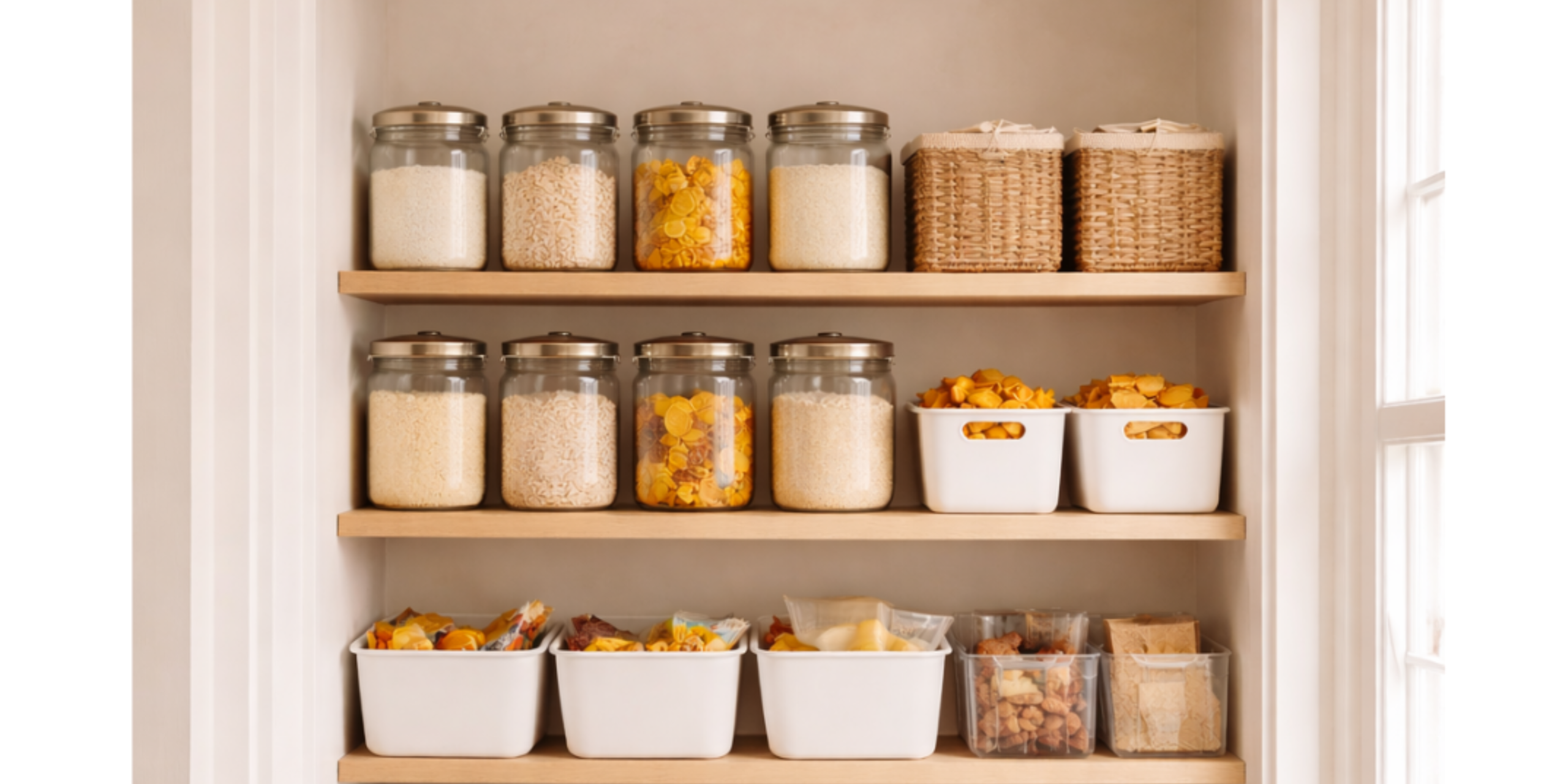
Choose systems that are fast to maintain. Baskets, open bins, and simple storage solutions often outperform highly detailed systems.
Many people abandon organizing systems because putting things away takes too long.
ADHD-friendly systems favor fast resets:
✅️ A useful rule
If resetting a room takes more than 5–10 minutes, the system is probably too complicated.
“I know it’s somewhere in the house” creates endless searching.
Choose one primary home for high-friction items:
Fewer locations = fewer searches.
Containers create natural boundaries and help prevent clutter from expanding beyond manageable limits.
Containers work best as boundaries, not just storage.
Instead of asking “How much should we keep?”, ask “How much fits comfortably in this container?”
Examples:
When the container is full, something must leave before something new enters.
Create systems that still work when you’re tired, busy, distracted, or overwhelmed.
A system that only works when you’re focused, motivated, and well-rested isn’t a reliable system.
Ask: What happens when I’m tired, distracted, or overwhelmed?
Examples:
Good systems survive imperfect days.
Attach small organizing tasks to habits you already have. Tiny, consistent actions are more sustainable than occasional large projects.
Instead of scheduling massive organizing sessions, attach tiny resets to things you already do.
Examples:
|
Existing routine |
2-minute reset |
|
Start coffee |
Unload a few dishwasher items |
|
Brush teeth |
Put away bathroom items on the counter |
|
After dinner |
Clear one visible surface |
|
Before bed |
Return items to the entryway drop zone |
Consistency beats intensity.
Create an entryway drop zone, organize one clutter hotspot, establish homes for recurring items, use clear containers, create an active project basket, and implement a 5-minute daily reset.
✅️ If your home feels overwhelming, start with this order:
Organizing cannot eliminate distraction, create motivation on demand, or solve every challenge associated with ADHD.
What it can do is reduce visual noise, reduce searching, reduce forgotten tasks, reduce decision fatigue, and reduce the effort required to start and finish routine activities.
That’s often enough to make daily life feel noticeably lighter.
At Minimize & Organize Co., we believe organizing should support real life—not create another standard to fail. ADHD-friendly organizing isn’t about being perfectly tidy. It’s about building systems that are visible, forgiving, easy to reset, and realistic to maintain.
If a space works better for you after a long week, a busy day, or a distracted afternoon, it’s already a successful organizing system.
Need help creating an ADHD-friendly home system? We help clients simplify storage, create low-maintenance routines, and design organizing systems that are easy to use on real-life days—not just ideal ones.
Whenever you are ready, we would love to help you build a home that works for you.
We use cookies to improve your experience on our site. By using our site, you consent to cookies.
Manage your cookie preferences below:
Essential cookies enable basic functions and are necessary for the proper function of the website.
These cookies are needed for adding comments on this website.
Statistics cookies collect information anonymously. This information helps us understand how visitors use our website.
Google Analytics is a powerful tool that tracks and analyzes website traffic for informed marketing decisions.
Service URL: policies.google.com (opens in a new window)
You can find more information in our Cookie Policy and .