Less about how a room looks. More about whether it works for the kid living in it.
AUG 25, 2026
A parent said something to us recently that’s stuck around: “I don’t need it to look like a magazine. I need him to be able to find his own socks.” That’s the whole job, really. A kid’s room doesn’t need to be styled — it needs to work for the specific kid who lives in it, including the ones who lose momentum halfway through putting laundry away, or who genuinely cannot see what’s inside a closed bin without opening every single one first.
This isn’t about diagnosing anyone or applying a medical framework to a bedroom. It’s about a handful of organizing principles that make a real difference for kids who get overwhelmed by too many steps, too many choices, or too much visual clutter — and, honestly, these same principles tend to make life easier for every kid and every adult in the house.
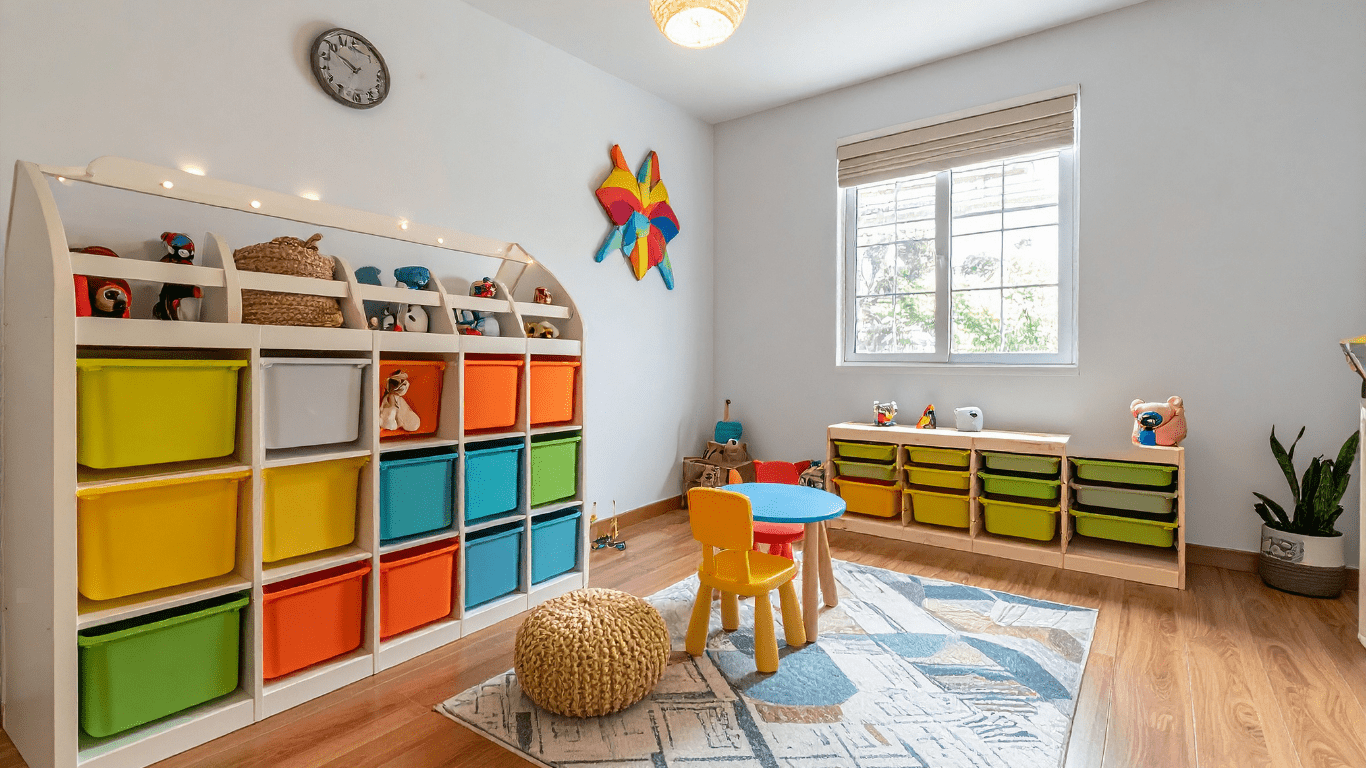
The instinct with kids’ clutter is to hide it — lids on, doors closed, everything tucked away. But for a lot of kids, out of sight really does mean out of mind. If toys live in a deep opaque bin, they get forgotten and the same five toys end up on the floor every day. Open bins, low shelves, and clear containers let a kid see their own options without digging. It costs you a little bit of visual tidiness. It buys you a room that actually gets used and actually gets put back together.
A closet organized into fourteen narrow categories — dress socks, athletic socks, short-sleeve tees, long-sleeve tees — sounds thorough, but it asks a child to make fourteen small decisions every time they get dressed or put something away. That’s a lot of decision-making for a five-minute task. We’ll usually consolidate down to five or six broad categories per space: tops, bottoms, pajamas, “special,” and so on. Broader categories mean fewer decisions, and fewer decisions mean a system that survives an actual Tuesday morning.
If putting something away takes more than one motion — unzip a bin, lift a lid, move something else out of the way first — it usually doesn’t happen. The goal is a home for each item that a kid can return something to in a single motion: toss it in an open bin, hang it on a low hook, drop it in a labeled basket. If your child is stepping over the same three items every day, it’s worth asking honestly whether the current home for that item requires too many steps to reach.
The room that stays tidy isn’t the one with the most storage. It’s the one where putting things away takes less effort than leaving them out.
Closet: Hang what you can at a height your child can reach without help. Use a few large open bins on a low shelf instead of many small labeled drawers. Keep out-of-season or special-occasion clothing somewhere else entirely, so daily choices stay simple.
Toy and play area: Rotate rather than store everything visible at once. A room with fewer toys out at a time is genuinely easier for a child to reset — and to actually play in — than one with every toy accessible all the time.
Desk and homework space: Keep the surface itself nearly empty. Supplies belong in one caddy or drawer nearby, not spread across the desktop, so the workspace resets to “ready” in seconds rather than requiring a clear-off first.
A system designed entirely by a parent, without the kid’s input, tends to reflect how the parent thinks — not how the kid actually operates. Ask where they naturally drop their backpack. Ask which drawer they actually open first. Build the system around those real habits instead of the ones you wish they had. A ten-minute conversation up front saves months of a system nobody uses.
Labels are a wonderful tool for adults and for kids who are strong readers and enjoy the structure. For a lot of younger or easily-overwhelmed kids, though, a picture or a color code does more work than text. A photo of folded shirts taped to a bin, or a simple color system — blue bin for pajamas, green for play clothes — removes a reading step from an already multi-step task.
The most sustainable systems don’t rely on anyone remembering a rule. They rely on the room itself cueing the right behavior — an open bin that’s obviously for shoes, a hook that’s obviously the backpack’s spot. When a system needs an adult to keep narrating the rules, it’s usually a sign the system needs adjusting, not the kid.
If you’re working on a room like this and want a second set of eyes, we’d love to help you think through what will genuinely work for your child’s specific habits — not a generic template, but a system built around how your family actually lives.
We use cookies to improve your experience on our site. By using our site, you consent to cookies.
Manage your cookie preferences below:
Essential cookies enable basic functions and are necessary for the proper function of the website.
These cookies are needed for adding comments on this website.
Statistics cookies collect information anonymously. This information helps us understand how visitors use our website.
Google Analytics is a powerful tool that tracks and analyzes website traffic for informed marketing decisions.
Service URL: policies.google.com (opens in a new window)
You can find more information in our Cookie Policy and .