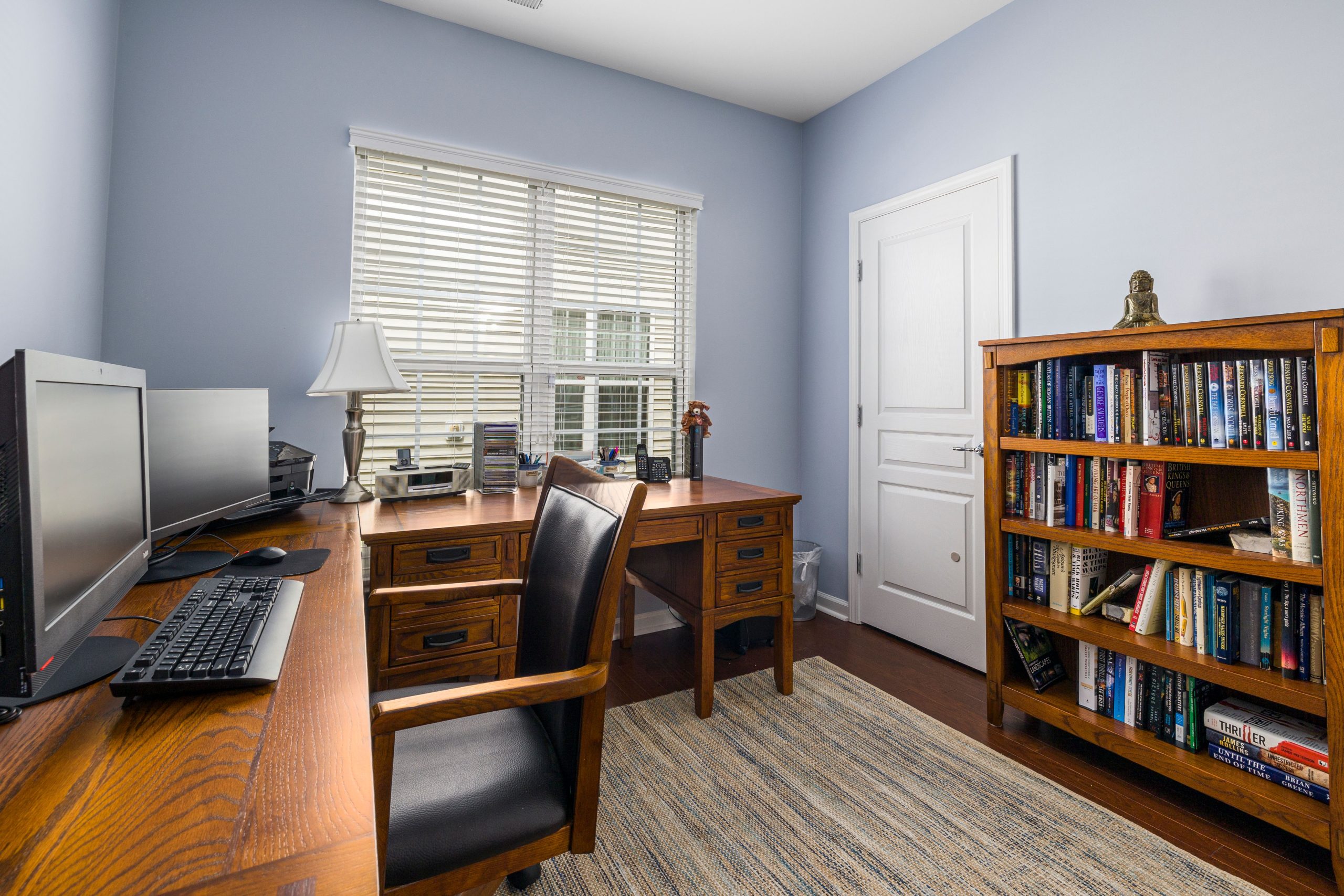
For the households doing remote work and remote learning under the same roof.
SEPT 01, 2026
A lot of the homes we work in on the Eastside have someone working from home at least part of the week — Microsoft, Amazon, a hybrid schedule, a business run out of a spare room. When school is also in session, that same house suddenly needs to hold a work call, a math worksheet, and a snack, sometimes all at the same table. August is the right time to get ahead of that, before the calendar fills back up.
The goal isn’t to build a matching his-and-hers office suite. It’s to make sure your work setup and your kids’ homework setup each have what they need to function, even if they’re sharing a room.
Walk through last school year honestly. Where did work paperwork end up living — a real filing system, or a stack that migrated around the house? Where did your kid actually do homework — at a desk, or wherever there was room on a given night? Most home office frustration isn’t a supply problem. It’s a system that was never quite decided on, so everything defaults to whatever surface is clear.
If your office doubles as the homework spot, the fix isn’t necessarily more furniture — it’s clearly separated zones. A desk with two distinct sides, or a rolling cart that holds all the kid’s supplies and can be tucked away when it’s not homework time, keeps the two functions from bleeding into each other. The version to avoid is one shared surface where your laptop, your child’s worksheets, and yesterday’s mail all compete for the same six inches of space.
If your office doubles as the homework spot, the fix isn’t necessarily more furniture — it’s clearly separated zones. A desk with two distinct sides, or a rolling cart that holds all the kid’s supplies and can be tucked away when it’s not homework time, keeps the two functions from bleeding into each other. The version to avoid is one shared surface where your laptop, your child’s worksheets, and yesterday’s mail all compete for the same six inches of space.
This is the piece that saves the most stress by October. Set up two simple homes for paper: an Action tier for anything that needs a signature, a response, or a decision this week, and a File tier for anything you need to keep but don’t need to act on. Everything else — flyers, expired coupons, last month’s newsletter — gets recycled the day it arrives. A stack of “I’ll deal with this later” paper is almost always the first thing to spiral in a shared workspace.
A homework zone works best when it’s boring in the best sense — the same few supplies, always in the same place, so no part of homework time is spent hunting for a pencil. One caddy with the basics (pencils, eraser, ruler, a calculator, headphones if needed) covers most of what’s needed on a given night. Keep it stocked as its own small habit, refilled during your Sunday reset rather than mid-homework.
The best home office setup is the one that requires the least thinking to use correctly, day after day.
If a work call and a homework session are going to happen in the same room at the same time, a small visual or physical boundary helps more than you’d expect — a room divider, a pair of noise-cancelling headphones for either party, or simply an agreed-on signal for “I’m on a call, please wait.” It’s a small thing, but naming it out loud as a household rule, rather than assuming everyone will just figure it out in the moment, prevents a lot of mid-meeting interruptions.
While you’re setting up the physical space, it’s worth a short pass on the digital side as well — a shared family calendar that both parents and older kids can see, and a consistent place (one folder, one app) where school forms that arrive digitally actually get saved, instead of scattered across email, texts, and screenshots.
None of this requires a renovation. Most of the home offices and homework zones we help set up use furniture the family already owns — just reorganized with a clearer purpose for each surface and a real home for paper. Do this work in August, and by the time the first project due date or work deadline collides with a school event, the space itself won’t be adding to the stress.
If you’d like a second opinion on how to make a shared space work for both a workday and a school day, that’s a project we genuinely enjoy — it tends to make the biggest visible difference for the least amount of furniture.
We use cookies to improve your experience on our site. By using our site, you consent to cookies.
Manage your cookie preferences below:
Essential cookies enable basic functions and are necessary for the proper function of the website.
These cookies are needed for adding comments on this website.
Statistics cookies collect information anonymously. This information helps us understand how visitors use our website.
Google Analytics is a powerful tool that tracks and analyzes website traffic for informed marketing decisions.
Service URL: policies.google.com (opens in a new window)
You can find more information in our Cookie Policy and .