Decluttering First: Clearing the Floor to Create a Blank Slate
OCT 19, 2026
Before building an efficient storage system, you must first assess what you are keeping. Garages often become a default dumping ground for seasonal items and household overflow. Pulling everything out to sort into keep, donate, and toss piles creates the clean slate needed to build a functional, streamlined space.
Before removing a single item, ask a simple question:
What do we actually need our garage to do?
A garage might serve several purposes at once.
It could be:
The problem begins when the garage becomes a storage area without any defined boundaries.
When everything belongs everywhere, nothing has a clear home.
Instead, think of the garage as a collection of functional zones.
For example:
Sports zone: bikes, helmets, balls, rackets, camping equipment
Garden zone: soil, pots, gardening tools, hoses
Workshop zone: tools, hardware, workbench supplies
Seasonal zone: holiday decorations, seasonal clothing, outdoor cushions
Household zone: extra paper goods, cleaning supplies, replacement items
Automotive zone: car care products, emergency supplies, windshield fluid
The exact zones should reflect your household rather than a generic garage checklist.
One of the most common garage organization mistakes is buying storage products too early.
It is tempting to walk into a home improvement store and purchase shelves, bins, hooks, cabinets, and organizers before deciding what you actually need to store.
That can create an expensive version of the same problem.
Instead, start by editing the contents.
Create broad categories:
Keep
Items you actively use or genuinely need.
Donate
Items that are useful but no longer belong in your household.
Sell
Higher-value items that you intentionally want to sell.
Recycle
Materials that should be recycled rather than stored indefinitely.
Dispose
Broken, expired, damaged, or unusable items.
Relocate
Items that belong somewhere else in the home.
This process is important because organization should respond to the belongings you actually own.
Not the belongings you might own someday.
Garage clutter can be surprisingly difficult to make decisions about because many items are connected to a possible future.
You might keep something because:
“I might need this someday.”
“We could use this if we start that project.”
“This could be useful.”
“I paid a lot for it.”
“It might come in handy.”
Instead, ask:
These questions shift the decision from “Could I use this?” to “Does this deserve space in my home?”
That distinction can dramatically change the amount of storage you need.
Not everything in your garage should be equally accessible.
The items you use every week should be easier to reach than the items you use once a year.
Think about three levels of accessibility.
High-use items
These should be easy to grab without moving other belongings.
Examples:
Occasional-use items
These can live farther back or higher up.
Examples:
Rare-use items
These can occupy the least convenient storage locations.
Examples:
A good organizing system does not simply make everything look neat.
It makes the right things easy to reach.
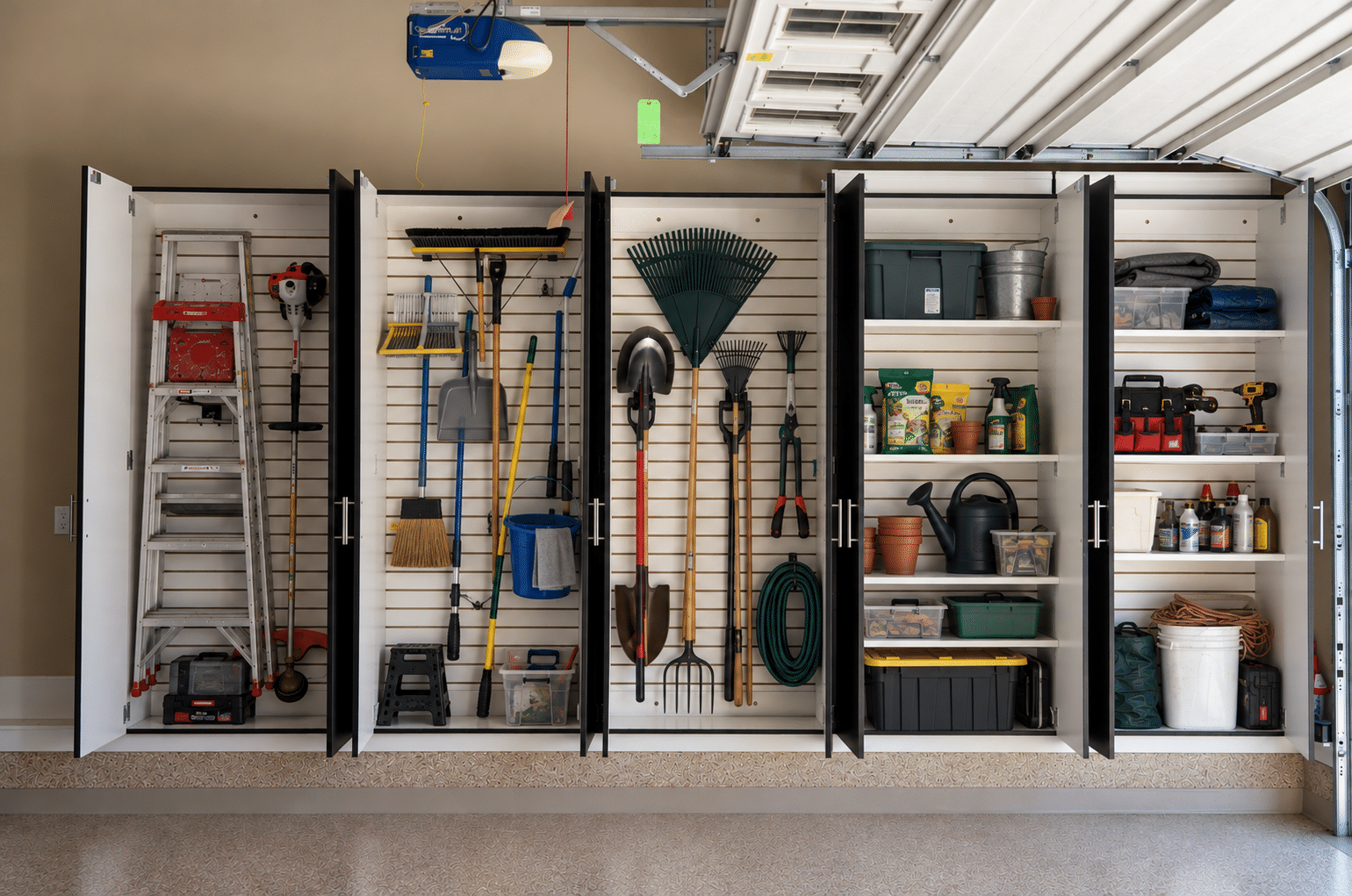
Garage floors disappear quickly.
Cars need room. Bikes need room. Work areas need room. Doors need to open. People need to walk safely.
That makes vertical storage especially valuable.
Depending on the garage, useful solutions can include:
The goal is not to put everything on the walls.
The goal is to move appropriate items out of valuable floor space while keeping frequently used belongings accessible.
If batteries are in three different places, tools are scattered across several shelves, and sports equipment is mixed with holiday decorations, your garage may technically contain storage but still feel disorganized.
Grouping similar belongings reduces search time.
Instead of:
Tools → everywhere
Create:
Hand tools → one zone
Power tools → one zone
Hardware → one zone
Garden tools → one zone
The same principle applies to sports equipment, holiday decorations, outdoor entertaining supplies, and household overflow.
When categories have boundaries, everyone in the household can understand where things belong.
Labels are useful when they answer a question.
For example:
Holiday Lights
is more helpful than:
Seasonal
if the bin contains only holiday lights.
Good labels make it easier to put things away correctly.
They are especially useful when:
Do not label every individual item simply because you can.
Label the categories that make the system easier to understand.
An organized garage should still be a garage.
You need room to:
A common mistake is using every available inch for storage.
More storage is not always better.
Sometimes the best organization decision is intentionally leaving empty space.
Empty space provides flexibility.
It allows the system to absorb life without immediately becoming cluttered again.
One of the most important parts of garage organization happens after the organizing project.
Ask:
Where will the next item go?
If your family buys a new bike, where does it live?
If you purchase another holiday decoration, where does it go?
If you acquire a new tool, what happens to the old one?
A functional garage needs a simple rule:
New items need a designated home before they become part of the household.
That may mean using a one-in, one-out approach for certain categories.
It may mean setting a maximum number of bins.
Or it may simply mean creating enough breathing room that new items do not immediately become floor clutter.

An organized garage is not one that stays untouched.
It is one that can recover quickly.
That is a major difference.
Real households use their garages.
Sports seasons change. Children grow. hobbies change. Holiday decorations come out and go back into storage. Tools are used. Projects start and finish.
Your garage should be able to adapt.
The best garage organization systems are therefore functional, visible, accessible, and flexible.
The goal is not perfection.
The goal is to know where things belong and make putting them away easier.
Sometimes the hardest part is not the organizing itself.
It is knowing where to begin.
Professional home organization can help when:
A professional organizer can help with the decisions, physical sorting, categorization, space planning, and system design.
For a Redmond household with bikes and trail gear, the system may look very different from a Kirkland household focused on gardening and seasonal storage. Bellevue homes may have different storage constraints depending on whether the home is a downtown condo, townhome, or larger property.
The organizing system should fit the household.
Keep items that are appropriate for garage storage and that your household actually uses. Common categories include tools, outdoor equipment, sports gear, gardening supplies, seasonal decorations, and automotive supplies.
It depends on what you store. Clear containers can make frequently accessed items easier to identify, while opaque containers can create a cleaner visual appearance for seasonal or less frequently used belongings. The best choice is the one that makes your system easier to maintain.
Prioritize function. Decide what must stay in the garage, create zones, use vertical storage where appropriate, and keep frequently used items within easy reach. Avoid filling every available space with storage.
A full reset should not be necessary frequently if the system is working. A seasonal reset can help rotate equipment, remove items that no longer belong, and restore categories that have drifted.
Your garage does not need to hold everything.
It needs to hold the right things, in the right places, in a way that works for your household.
With thoughtful decluttering, clear zones, accessible storage, and systems designed around how you actually live, your garage can become one of the most functional spaces in your home.
For homeowners in Kirkland, Bellevue, Redmond, and the Greater Eastside, Minimize & Organize Co. creates customized home organization systems designed around real routines, real spaces, and real belongings.
Ready to create a home that feels calmer, more functional, and beautifully organized?
We use cookies to improve your experience on our site. By using our site, you consent to cookies.
Manage your cookie preferences below:
Essential cookies enable basic functions and are necessary for the proper function of the website.
These cookies are needed for adding comments on this website.
Statistics cookies collect information anonymously. This information helps us understand how visitors use our website.
Google Analytics is a powerful tool that tracks and analyzes website traffic for informed marketing decisions.
Service URL: policies.google.com (opens in a new window)
You can find more information in our Cookie Policy and .